
Japanese Industry Leaders Visit Dholera
JBIC–JETRO led mission supported by JCCII toured Dholera International Airport, semiconductor plant, utilities and smart-city facilities, signalling rising Japanese interest in India’s flagship industrial and electronics manufacturing zone.
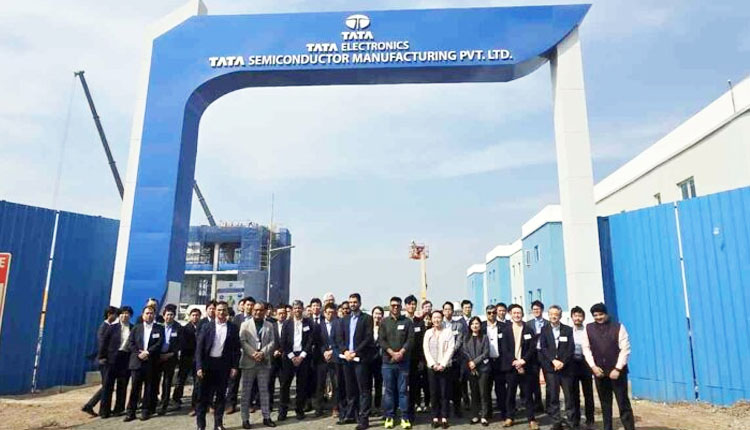
Japanese delegation at TATA Semiconductor facility in Dholera SIR
Dholera, Ahmedabad (January 29, 2026): A high-level industry and institutional delegation co-organized by the Japan Bank for International Cooperation (JBIC) and the Japan External Trade Organization (JETRO) undertook a comprehensive field visit to the Dholera Special Investment Region (SIR) in Gujarat on Thursday, January 29, 2026, as India’s flagship industrial zone moved into sharper global focus for its ambition to become the country’s first integrated semiconductor and electronics manufacturing hub. The mission, supported by the Japan Chamber of Commerce and Industry in India (JCCII), brought together representatives from Japanese companies, financial institutions, and trade bodies to assess on-the-ground infrastructure and investment readiness.
Japanese delegation at Dholera International Airport Officials from the National Industrial Corridor Development Corporation (NICDC), Ministry of Commerce, New Delhi, and Dholera Industrial Development Limited (DIDL), Gujarat, updated the delegation on the project’s development.
The organisers were represented by key officials, including Akiyama and Sakura Shibuya from JBIC, Satoru Iida from JETRO, Jiro Kodera from the Embassy of Japan, and Tomoya Miyamoto from JCCII, who served as the principal points of coordination and engagement for the delegation. The tour brought together around 45 participating organisations, reflecting a cross-section of Japanese and Japan-linked business interests in India.
Fire Station at Dholera Intnational Airport
The group included representatives from trading houses, logistics and supply-chain companies, major banking and financial institutions, chemical and materials firms, electronics and technology manufacturers, industrial machinery firms, research and consulting entities, and business associations, along with officials from the Japanese diplomatic and business community in India.
This diverse composition underscored that interest in Dholera SIR extended well beyond a single sector, spanning finance, infrastructure, advanced manufacturing, and high-technology industries aligned with the development of a semiconductor and electronics ecosystem.
Participants assembled early in the morning in Ahmedabad before traveling by road to Dholera, a greenfield smart industrial city located roughly two hours from the state’s commercial capital. Organisers advised outstation delegates to arrive in Ahmedabad the previous evening to ensure timely participation at the early start, underscoring the packed schedule and the importance of the visit.
The delegation first attended an orientation session at Le Meridien Ahmedabad, after which they proceeded toward Dholera SIR. Once at the site, officials and industry members were given a structured overview of the region’s core physical infrastructure, which has been positioned as a key differentiator for high-technology manufacturing.
ABCD Building at Dholera SIR. The tour included a visit to the Water Treatment Plant, reflecting the region’s focus on sustainable industrial utilities, followed by the site earmarked for the TATA Semiconductor factory, a project widely seen as a cornerstone of India’s chip manufacturing ambitions. Delegates also inspected the Power Sub-Station, highlighting the assured and scalable power supply critical for semiconductor fabrication, and viewed the Canal Front Development, which forms part of the broader urban and environmental planning of the smart city.
A major component of the visit centred on the ABCD Building complex, where participants toured the Experience Centre and the Integrated Command & Control Centre. These facilities demonstrated the digital backbone of Dholera SIR, including real-time monitoring and smart-city management systems that support advanced industrial operations and urban services. The presentation of these control and planning systems reinforced Dholera’s positioning not merely as an industrial estate, but as a technology-enabled manufacturing ecosystem.
Several prominent companies and institutions were represented in the delegation, reflecting strong Japanese corporate interest in India’s emerging semiconductor and electronics ecosystem. Among the participating organisations were Tata Electronics (TATA Semiconductor project site host), Mitsubishi Chemical India, Mitsui & Co. India, Sumitomo Mitsui Banking Corporation (SMBC), Resona Bank, Standard Chartered Bank (Japan Desk), The Hongkong and Shanghai Banking Corporation (HSBC), FUJITA Engineering, Yusen Logistics India, Kintetsu World Express (India), ACN Network, JP Morgan, alongside firms in industrial machinery, chemicals, research services, media and professional consulting as well as business bodies and ecosystem enablers like JCCII and JETRO New Delhi and Ahmedabad.
The presence of trading houses, global banks, logistics majors, chemical and materials companies, and advanced manufacturing stakeholders highlighted that the Dholera SIR initiative was being viewed not just as a factory site, but as the foundation of a broader semiconductor, electronics and high-technology industrial cluster with integrated supply chain, finance, and infrastructure support.
Work in progress at the TATA Semiconductor facility in Dholera SIR Over lunch in Dholera, discussions continued informally on supply chains, policy support and the potential role of Japanese technology and investment in India’s semiconductor and electronics value chain. The visit concluded with the delegation departing Dholera in the afternoon for Ahmedabad Airport, where the program formally ended. Organisers noted that the schedule and order of site visits were subject to change based on traffic and local conditions, reflecting the dynamic nature of field missions at this scale.
The mission underscored growing Japan–India industrial cooperation at a time when global semiconductor supply chains are diversifying. Dholera SIR, with its planned large-scale infrastructure, dedicated industrial zones and smart-city framework, was presented as a strategic platform where advanced manufacturing, particularly semiconductors and electronics, could take root in India with strong international participation.